
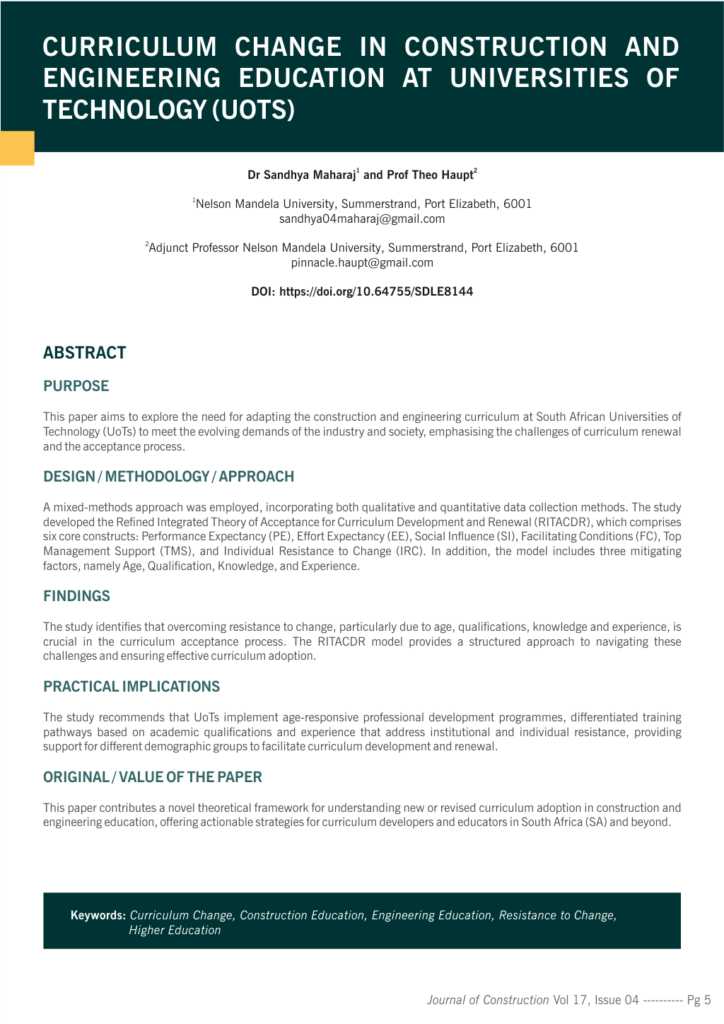
CURRICULUM CHANGE IN CONSTRUCTION AND ENGINEERING EDUCATION AT UNIVERSITIES OF TECHNOLOGY (UOTS)
Dr Sandhya Maharaj and Prof Theo Haupt
Published: Journal of Construction, Volume 17, Issue 04
DOI: https://doi.org/10.64755/SDLE8144
Keywords: Curriculum Change, Construction Education, Engineering Education, Resistance to Change, Higher Education
ABSTRACT
PURPOSE
This paper aims to explore the need for adapting the construction and engineering curriculum at South African Universities of Technology (UoTs) to meet the evolving demands of the industry and society, emphasising the challenges of curriculum renewal and the acceptance process.
DESIGN / METHODOLOGY / APPROACH
A mixed-methods approach was employed, incorporating both qualitative and quantitative data collection methods. The study developed the Refined Integrated Theory of Acceptance for Curriculum Development and Renewal (RITACDR), which comprises six core constructs: Performance Expectancy (PE), Effort Expectancy (EE), Social Influence (SI), Facilitating Conditions (FC), Top Management Support (TMS), and Individual Resistance to Change (IRC). In addition, the model includes three mitigating factors, namely Age, Qualification, Knowledge, and Experience.
FINDINGS
The study identifies that overcoming resistance to change, particularly due to age, qualifications, knowledge and experience, is crucial in the curriculum acceptance process. The RITACDR model provides a structured approach to navigating these challenges and ensuring effective curriculum adoption.
PRACTICAL IMPLICATIONS
The study recommends that UoTs implement age-responsive professional development programmes, differentiated training pathways based on academic qualifications and experience that address institutional and individual resistance, providing support for different demographic groups to facilitate curriculum development and renewal.
ORIGINAL / VALUE
This paper contributes a novel theoretical framework for understanding new or revised curriculum adoption in construction and engineering education, offering actionable strategies for curriculum developers and educators in South Africa (SA) and beyond.
 Next Post