

JOURNAL OF CONSTRUCTION | VOLUME 18 | ISSUE 02
ISSN: 1994 – 7402
PUBLISHED BY: Association of Schools of Construction of Southern Africa (2025)
DOI: https://doi.org/10.64755/ROBZ5592
CONTENTS
- AIMS AND SCOPE (PG 2)
- ADVISORY BOARD (PG 3)
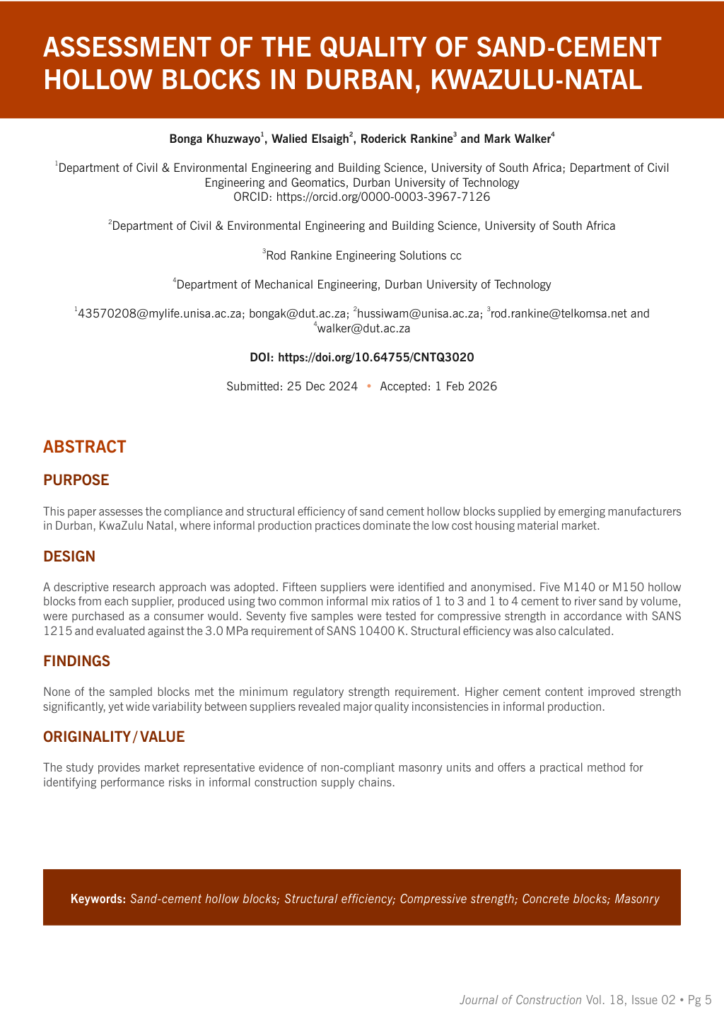
- ASSESSMENT OF THE QUALITY OF SAND-CEMENT HOLLOW BLOCKS IN DURBAN, KWAZULU-NATAL (PG 5)
Bonga Khuzwayo, Walied Elsaigh, Roderick Rankine and Mark Walker
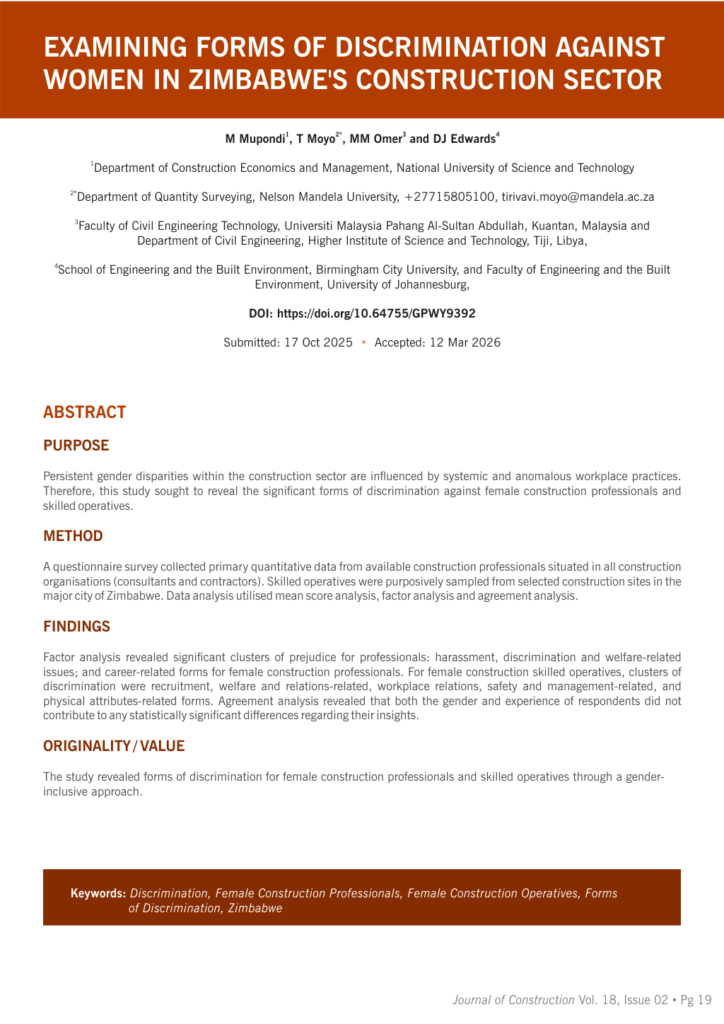
- EXAMINING FORMS OF DISCRIMINATION AGAINST WOMEN IN ZIMBABWE’S CONSTRUCTION SECTOR (PG 19)
M Mupondi, T Moyo, MM Omer and DJ Edwards
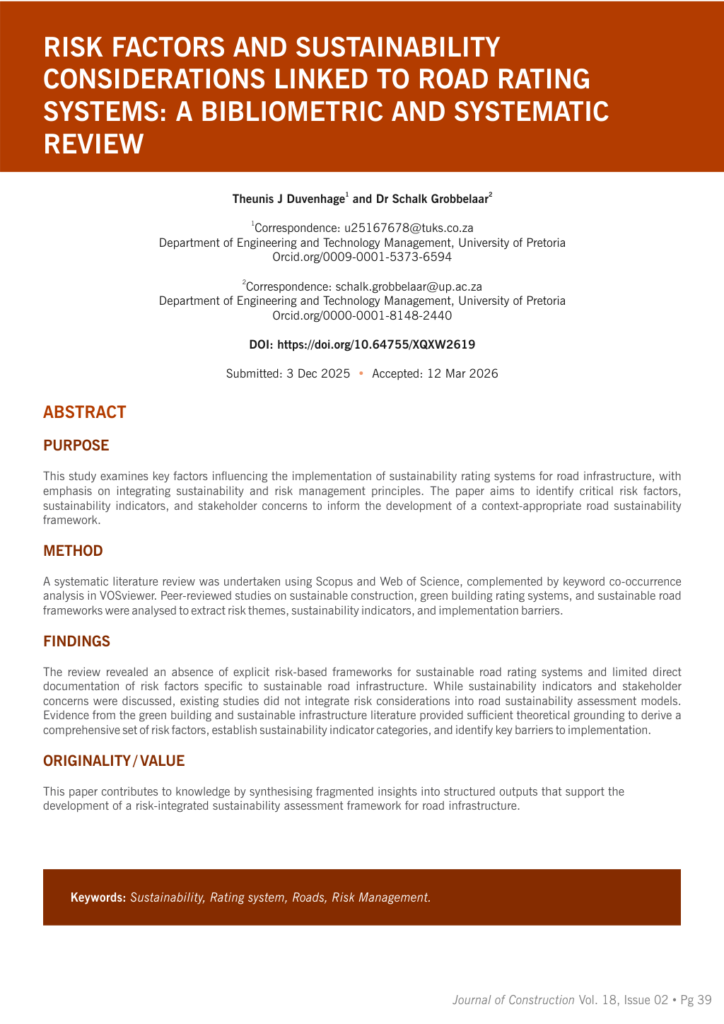
- RISK FACTORS AND SUSTAINABILITY CONSIDERATIONS LINKED TO ROAD RATING SYSTEMS: A BIBLIOMETRIC AND SYSTEMATIC REVIEW (PG 39)
Theunis J Duvenhage and Dr Schalk Grobbelaar
- A THEMATIC ANALYSIS OF FACTORS INFLUENCING THE APPLICATION OF GREEN BUILDING TECHNOLOGIES: INSIGHTS FROM A DEVELOPING COUNTRY (PG 51)
Rethabile Nkoe, Eric Kwame Simpeh and John Smallwood
- INSTRUCTIONS FOR AUTHORS (PG 68)
- EDITORIAL COMMITTEE (PG 71)
Click to read individual papers published in Volume 18, Issue 02 of the Journal of Construction open articles series.

LETTER FROM THE EDITORS
This first normal issue in Volume 18 contains four papers. The paper by Khuzwayo, Elsaigh , Rankine and Walker assesses the compliance and structural efficiency of sand cement hollow blocks supplied by emerging manufacturers in Durban, KwaZulu Natal, where informal production practices dominate the low-cost housing material market. They found that none of the sampled blocks met the minimum regulatory strength requirement and that wide variability between suppliers revealed major quality inconsistencies in informal production. Consequently, the prevalent use of non-compliant masonry provides a means to identify potential performance risks when products such as these are used.
Mupondi, Moyo, Omer and Edwards argue in their paper that persistent gender disparities within the construction sector are influenced by systemic and anomalous workplace practices. They posit that there are significant forms and clusters of discrimination against female construction professionals and skilled operatives. These take the form of harassment, discrimination and welfare-related issues; and career-related forms for female construction professionals. For female construction skilled operatives, the discrimination clusters were recruitment, welfare and relations-related, workplace relations, safety and management-related, and physical attributes-related forms.
In their paper, Duvenhage and Grobbelaar examine key factors that influence the implementation of sustainability rating systems for road infrastructure, with emphasis on integrating sustainability and risk management principles. They identify critical risk factors, sustainability indicators, and stakeholder concerns to inform the development of a context-appropriate road sustainability framework. They found an absence of explicit risk-based frameworks for sustainable road rating systems and limited direct documentation of risk factors specific to sustainable road infrastructure.
In the final paper, Nkoe, Simpeh and Smallwood explore the key barriers to adoption and factors that will engender the adoption of Green Building Technologies (GBTs) in Lesotho. Their study showed that a lack of regulation and policy framework, as well as a lack of incentives, pose significant barriers to the adoption of GBTs in the country. They found that regulations and enforcement, the availability of demonstration projects, incentivising and rewarding, and creating an enabling environment would contribute to engendering the adoption of GBTs in the Lesotho construction industry.
The editorial team trust that you will enjoy reading the papers in this issue and invite any comments and critiques of the work presented.
Prof. Theo Haupt
Overseeing Editor for the Editorial Team